
The Ultimate Sicily Itinerary: 5 Days in Sicily (2026)
Spending five days in Sicily is enough to experience some of the island’s biggest highlights, but only if you plan your route carefully. Sicily is much larger than many travelers expect, and with so many beautiful towns, coastal drives, historical sites, and incredible food stops, deciding where to spend your time can quickly become the hardest part of the trip. From the slopes of Mount Etna to the baroque towns of southeastern Sicily and the lively coastal cities, every corner of the island feels completely different.
One of the things I love most about Sicily is how much variety you can experience in a short amount of time. In a single day, you can explore ancient Greek ruins, drive through volcanic landscapes, and finish the evening surrounded by elegant baroque architecture. The challenge is that distances between some of the best destinations in Sicily are longer than they appear on a map, so trying to see too much in five days can leave you spending more time in the car than actually enjoying the island.
That’s why this 5-day Sicily itinerary follows a practical east-to-west route, starting in Taormina and gradually making its way across the island without unnecessary backtracking. It covers Sicily’s biggest highlights while keeping driving times realistic, giving you enough time to explore rather than constantly rushing to the next stop.
Disclosure: This blog post contains affiliate links. I may receive a small commission for purchases or bookings made through these links, at no extra cost to you. I only recommend products and services that I’ve personally used and genuinely like. By using my links, you help support my blog and allow me to continue creating helpful free travel guides like this one, while probably funding my next cappuccino or gelato along the way. For more info, please read the privacy policy.
5-Day Sicily Itinerary – Quick Tips
Dive right into my top picks for hotels, tours, places to visit, insider tips, and more, and make the most of your five days in Sicily. Your journey starts here!
🛏️ Best Places to Stay
- Belduomo in Taormina
- Palazzo Russo Ortigia in Syracuse
- Doric Eco Boutique Resort & Spa in Agrigento
- LOCANDA SANTAMARINA Dimora di Charme in Palermo
🗺️ Travel Planning Tips
- Best Time to Visit | May, June, September, October
- How to Get Around | Rental Car, Public Transport
- Top Places to Visit | Palermo, Taormina, Catania, Mount Etna, Ortigia, Valley of the Temples, Ragusa, Céfalu
- Insider Tips | Scicli, Modica, Erice, Gole Alcantara
- Stay Connected | Get your Europe eSIM 📱
🌟 Best Tours & Experiences
Keep reading for my complete Sicily travel guide!
How to Get to Sicily
If you’re flying to Sicily, the two main airports are Catania-Fontanarossa Airport on the east coast and Palermo Airport on the northwest side of the island. For this itinerary, flying into Catania usually makes the most sense because the route starts in Taormina, which is about a one-hour drive away.
If you’re arriving by car, Sicily is very easy to reach from mainland Italy via ferry from Villa San Giovanni to Messina. The crossing only takes around 20 to 30 minutes, ferries run frequently throughout the day, and it’s a simple process even during busier travel months. This is the option we chose while road-tripping south after the Amalfi Coast before continuing later toward Matera and Puglia.
How to Get Around Sicily
If you’re planning a 5-day Sicily road trip itinerary like ours, renting a car is by far the best option. Distances between the main highlights are longer than they often seem on the map, and many of the most memorable stops are the smaller places you pass along the way rather than only the major cities. Having your own car also gives you the freedom to stop whenever you spot a quiet viewpoint, a local restaurant, or one of those villages that make you immediately want to pull over.
A rental car becomes even more useful once you leave places like Catania, Syracuse, or Palermo, where public transport is more available. Smaller towns such as Ragusa or Trapani are much easier to reach by car, especially if you want to keep your route efficient.
Public transport is still possible if you prefer not to drive, but it works best if you stay in one or two of the larger cities and plan day trips from there. The main limitation is flexibility, because connections between towns can take much longer and often make it difficult to fit several stops into one day.
🚘 MY GO-TO CAR RENTAL COMPANY: DISCOVER CARS
When booking a rental car online, I personally recommend and always use Discover Cars. The platform compares both major international car rental companies and smaller local agencies, which often helps find better deals. Plus, there are no hidden costs and they offer free cancellation if your plans change. I typically opt for full coverage since the rates are very reasonable and it gives extra peace of mind while traveling.
Best Time to Visit Sicily
The best time to visit Sicily is usually late April through June and again from September to October, which is also when we personally prefer traveling in Europe. These shoulder season months offer one of the best balances for a road trip across the island because temperatures are mild, prices are often better, and the main sights feel far less crowded than during peak summer.
Daytime temperatures in spring and early fall are often around 20 to 27°C (68 to 81°F), which makes long sightseeing days much more comfortable.
Summer is ideal if your priority is beach time, especially in places like San Vito lo Capo or Cefalù, but July and August can be intensely hot, with temperatures often climbing above 30°C (86°F) and sometimes well beyond that inland. Popular towns also become noticeably busier during these months, especially in the afternoons when cruise and day-trip visitors arrive.
Winter is quieter and often surprisingly mild compared with much of Europe, particularly along the coast. It can be a good option if you want lower hotel prices and fewer visitors, though some smaller restaurants, beach clubs, and seasonal shops may have reduced opening hours outside the main travel season.

Where to Stay in Sicily
Where you stay in Sicily depends entirely on how you want to structure your trip. If you prefer fewer hotel changes, you can base yourself in larger cities such as Palermo or Taormina and plan day trips from there. This works well if you want a slower pace and don’t mind returning to the same hotel each evening, especially in the eastern part of the island where several highlights are relatively close together.
For a route like this one, though, a road trip with overnight stops along the way usually makes far more sense. Sicily is large enough that constantly driving back and forth can quickly eat into your day, especially if you only have five days and want to cover several regions.
That’s why we chose to stay in the places we visited along the route, which made the itinerary feel much more manageable. Our overnight stops were Taormina, Syracuse, Agrigento, and Palermo. This keeps driving realistic while allowing you to enjoy the evenings in some of Sicily’s most amazing destinations rather than always arriving late and leaving early.
|
Overnight Stop |
Hotel Recommendation |
|---|---|
|
Taormina |
Belduomo ⭐9.5/10 |
|
Syracuse |
Palazzo Russo Ortigia ⭐9.0/10 |
|
Agrigento |
Doric Eco Boutique Resort & Spa ⭐9.5/10 |
|
Palermo |
5 Days in Sicily Itinerary at a Glance
Below is a quick look at our 5-day Sicily itinerary day by day. The route starts in the east and gradually moves across the island, combining major highlights with a few smaller stops along the way. This is the exact route we followed ourselves, and honestly, we’d structure it the same way again because it made the driving feel manageable while still covering a lot of the island.
Day 1 in Sicily: Taormina & Mt. Etna
- Wander through Taormina
- Visit Isola Bella
- Stop at Gole Alcantara Botanical and Geological Park
- Head up to Mount Etna
Day 2 in Sicily: Catania, Syracuse & Ortigia
- Stroll through in Catania
- See the Neapolis Archaeological Park
- Discover Ortigia in Syracuse
Day 3 in Sicily: Baroque Towns of Val di Noto
- Walk through Noto
- Stop at Scicli
- Visit Modica
- Admire Ragusa
Day 4 in Sicily: From Agrigento to Palermo
- Visit the Valley of the Temples
- Stop at Cefalù
- Alternative: Drive along the West Coast to Palermo
Day 5 in Sicily: Palermo & its highlights
- Experience Palermo’s historic center
In the following, you’ll find our detailed 5 days in Sicily itinerary, including what to do and see in Sicily, helpful tips for planning your days, and the highlights that are truly worth prioritizing.

Complete 5 Days in Sicily Itinerary

Day 1 in Sicily: Taormina & Mt. Etna
Day one is all about experiencing two very different sides of Sicily. It combines one of Sicily’s most charming towns with one of its most impressive natural landmarks. You’ll start the morning in Taormina, wandering through the historic center before the crowds arrive, then head into the dramatic landscapes of Mount Etna later in the day. From elegant piazzas to volcanic scenery, it’s one of the most varied and memorable days of the trip.
Wander through Taormina
Taormina is one of my absolute favorite places in Sicily. The town is compact enough to explore on foot, which makes it ideal for a relaxed morning before heading further inland. Most of the main sights are concentrated around the historic center, and the town itself is very much part of the experience, not just the landmarks.
The natural starting point is Corso Umberto, the main pedestrian street that runs through the heart of town. This is where you’ll pass small boutiques, cafés, historic buildings, and many of Taormina’s best viewpoints.
From there, continue toward Piazza del Duomo, where you’ll find the Taormina Cathedral, also known as St. Nicholas Cathedral. This part of town feels quieter than the central squares and is worth a short stop before heading back toward the livelier sections.


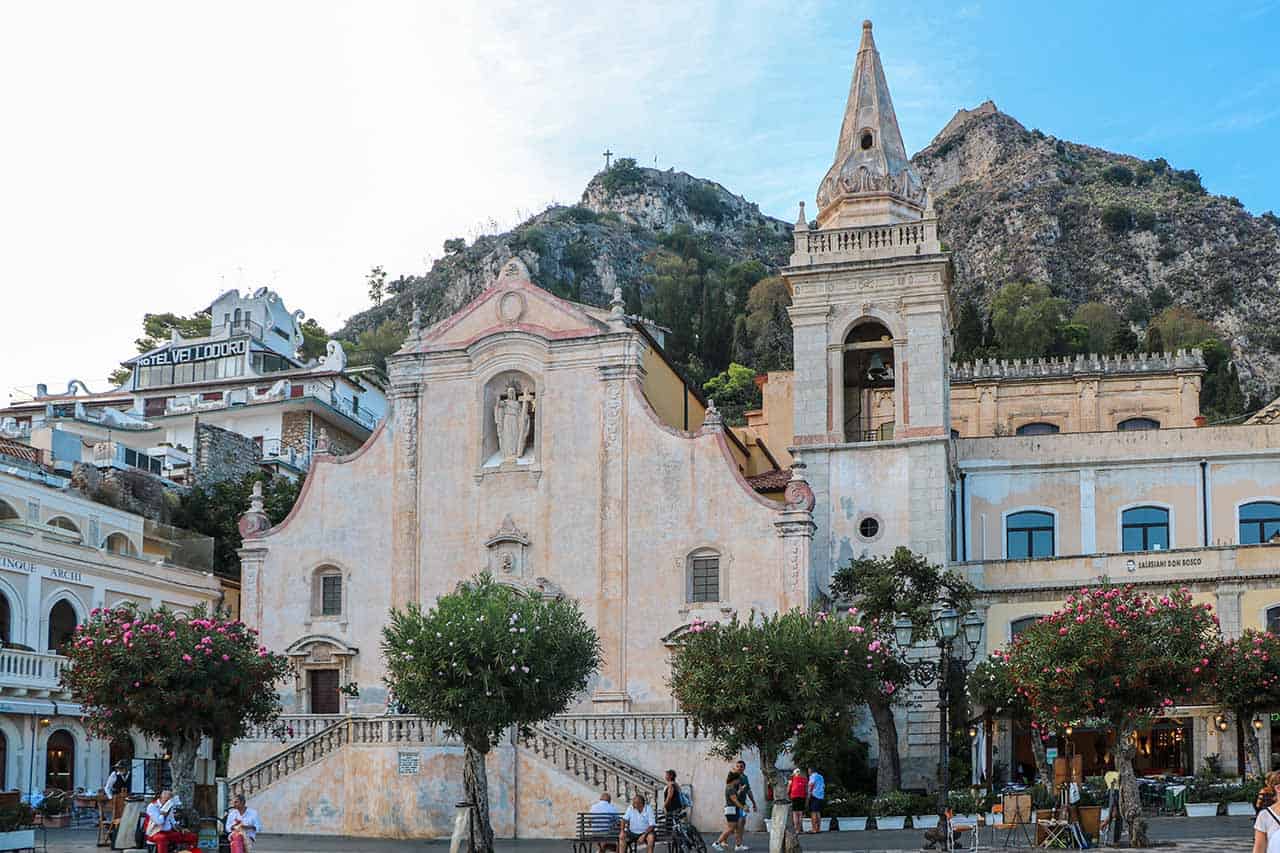
A little further along, Church of San Giuseppe opens onto Piazza IX Aprile, which is one of the most recognizable spots in town. The terrace here looks out over the coastline and toward Mount Etna, and it’s one of those places where people naturally slow down because the view is difficult to walk past quickly.
One stop that is often overlooked but very worth including is Villa Comunale di Taormina. These public gardens feel calmer than the central streets and offer some of the nicest panoramic views in town. We actually really enjoyed wandering through this part of Taormina because it felt quieter, greener, and like a nice break from the busier parts of the center.
Finish your Taormina walk at Teatro Antico di Taormina, the ancient Greek theater that remains one of Sicily’s most impressive historical sites. Even if you’ve seen many ancient theaters before, the setting here is what makes it memorable, with Mount Etna and the sea visible behind the stage.
💡 Looking for the best food experience in Taormina? One of the best ways to experience Sicilian culture is through its incredible food. I highly recommend joining this Sicilian Cooking Class, where you’ll learn how to prepare traditional local dishes and enjoy the meal you’ve created at the end of the experience.

Visit Isola Bella
After exploring Taormina, head down to Isola Bella, one of the most photographed coastal spots near Taormina, for a beach stop before continuing inland. The small island is connected to the shore by a narrow strip of sand, and depending on sea levels, you can often walk across.
This is a good place to slow down for a while, swim in the clear water, or simply enjoy the coastal views before continuing the day. Even if you only stay for an hour or two, it creates a nice contrast to the historic center before the afternoon shifts toward volcanic landscapes.
💡 Alternatively, you can join a boat tour around Taormina and Isola Bella, where you’ll cruise along the coastline and swim in some of the area’s crystal-clear grottos.
Stop at Gole Alcantara Botanical and Geological Park
Before heading to Mount Etna, make a stop at Gole Alcantara. This geological park is known for its striking basalt canyon formations created by ancient lava flows, and it offers a completely different landscape from the coast you’ve just left behind.
Even a short visit works well here, especially if you mainly want to see the gorge from below and walk the main viewing area. The rock formations are what make this stop memorable, with steep volcanic walls rising on both sides of the river. If you visit during warmer months, you can also step into the water, although it stays surprisingly cold throughout the year.


Head up to Mount Etna
From Alcantara, continue toward Mount Etna, the highest active volcano in Europe and one of Sicily’s defining natural landmarks. Driving up already feels dramatic because the scenery changes steadily from green hills to dark volcanic terrain.
Most visitors head to Rifugio Sapienza, where you can either stay around the lower crater area or take the cable car higher up. The cable car is the easiest way to experience Etna’s volcanic scenery without committing to a full guided hike, especially if you’re short on time.
On clear days, you can see far across the eastern coast, which makes the contrast between black lava fields and the sea especially impressive. Even without a guided excursion, walking around here already gives you a strong sense of Etna’s scale. The terrain feels almost lunar in parts, with black lava rock, wide open views, and very little vegetation at the higher sections.
💡 If you’d rather leave the logistics to someone else, this highly rated Etna and Alcantara Gorges tour is a great option. It combines two of the area’s most impressive natural attractions into one easy day trip.
After Mount Etna, return to Taormina for dinner and one final evening walk along Corso Umberto. Before ending the day, stop at La Pignolata Guinness Cannoli for cannoli. This was actually the first place we tried cannoli in Italy, and they were so good, so for us this is an easy must-try in Taormina.
Day 2 in Sicily: Catania, Syracuse & Ortigia
Day two combines a larger city stop with one of the most atmospheric places in Sicily. The morning is best spent in Catania, where baroque streets and busy local life feel very different from Taormina, before continuing south to Syracuse for ancient ruins and a slower evening in Ortigia. It’s a full day, but, in my opinion, the route works well because each stop offers something completely different.
Stroll through in Catania
We started the morning in Villa Bellini, one of the most pleasant green spaces in the city and a good first stop before heading into the busier streets. The gardens feel spacious and relaxed, which makes them a nice contrast before stepping into the more energetic center.
From there, it makes sense to walk down Via Etnea, which is the main street running through the center and lined with shops, cafés, and views toward Mount Etna on clear days. This is also where Catania feels most lively, especially in the morning when locals are already filling the cafés.
Along the way, you’ll pass the remains of the Roman Amphitheatre of Catania, which sits directly within the modern city and gives an immediate sense of how layered Catania feels historically. It’s one of those places where ancient ruins suddenly appear between everyday city buildings.

Continue toward Piazza Università, then on to Teatro Massimo Bellini, one of the city’s best-known landmarks. This part of the center feels elegant and slightly grander than the streets around Via Etnea.
The most iconic part of central Catania is Piazza del Duomo, where you’ll find the Elephant Fountain and Catania Cathedral, dedicated to Saint Agatha. This square is usually the busiest part of the city and naturally becomes the main stopping point for most visitors.
Right beside the square, the fish market gives this part of the city a much livelier feel, especially in the morning. Even if you don’t stay long, it’s worth passing through because it adds a more local side to the visit.
Next, head to Castello Ursino, where the surroundings feel slightly less polished and show another side of Catania beyond the main center. The castle itself stands out because of its heavy medieval architecture and the way it contrasts with the surrounding streets.
Nearby, the Teatro Romano di Catania adds another layer of the city’s Roman history. It’s a worthwhile stop if you enjoy seeing how much history is built directly into the city itself. Parts of the ancient structure are still remarkably visible despite being surrounded by later buildings.
A short walk from here brings you to the Monastery of San Nicolò l’Arena, a UNESCO World Heritage Site whose scale feels especially impressive compared with the more compact churches around the city. It’s one of the buildings that makes Catania’s baroque architecture feel especially monumental.


💡 If you want to go beyond the main sights, this private underground Catania tour is a fantastic experience. Led by an archaeology guide, it offers a fascinating look at the city’s hidden history and the stories buried beneath its streets
See the Neapolis Archaeological Park
From Catania, continue south to Neapolis Archaeological Park, one of Sicily’s most important archaeological sites. This area includes the Greek Theater, Roman amphitheater, and the famous Ear of Dionysius, all within one large archaeological complex. The site feels larger than many visitors expect, so it helps to allow enough time to explore it properly.
Even if you’re not usually drawn to ancient ruins, this stop feels worthwhile because of the scale and how well preserved parts of the site still are. The Greek Theater in particular is one of the highlights and remains especially impressive because of its setting.
Discover Ortigia in Syracuse
After the archaeological park, head into Ortigia, the old town of Syracuse and one of the places that immediately feels slower and more atmospheric. Compared with Catania, everything here feels more compact, with narrow streets, pale stone buildings, and a very different pace.
A natural starting point is the Temple of Apollo, before continuing into the smaller lanes that lead deeper into the historic center. This part of Ortigia is ideal for walking without a fixed route because many of the side streets open unexpectedly onto small squares and sea views.
Soon you’ll reach Fountain of Diana, which sits in the middle of one of Ortigia’s most recognizable squares, Piazza Archimede, and immediately draws attention with its sculptural detail.
Just a few steps further is Syracuse Cathedral, another UNESCO World Heritage Site built directly on the remains of an ancient Greek temple, which makes the facade especially striking once you notice the older columns integrated into the structure. We especially loved this part of Ortigia because the baroque piazzas and impressive facades give the whole center a very elegant feel, especially once the light starts softening later in the day.


Nearby, you’ll also pass Palazzo Arcivescovile, which adds to the grand feel of the cathedral square before the streets gradually open toward Fonte Aretusa. This freshwater spring right beside the sea is one of Ortigia’s most unusual spots and has long been tied to local myth and history.
From there, continue along the seafront toward Castello Maniace, the historic fortress at the tip of Ortigia island. The walk here gives you wide coastal views, and the setting becomes especially beautiful later in the afternoon when the light reflects off the water.
💡 If you have some extra time in Syracuse, I’d highly recommend joining this Sicilian Street Food Tour or this Ortigia Boat & Sea Cave Tour. Both offer a different perspective of the city, whether you want to discover its local food scene or explore the coastline from the water.
Day 3 in Sicily: Baroque Towns of Val di Noto
Day three was one of my favorite parts of this itinerary. You’ll spend the day exploring southeastern Sicily and its beautiful baroque towns, each with its own atmosphere and character. The pace feels a little more relaxed here, and the drive between the towns is just as enjoyable as the stops themselves. By the end of the day, you’ll arrive in Agrigento after one of the most scenic stretches of the entire trip.
Walk through Noto
A good place to start is Noto, often considered one of the most iconic baroque towns in Sicily. The historic center is very easy to explore on foot, with most of the main sights lined along Corso Vittorio Emanuele.
The first impression here is how harmonious the town feels, with warm-colored stone buildings and wide streets that immediately look different from the tighter layouts of other Sicilian towns.
A natural first stop is Porta Reale, which marks the entrance into the old town before the main street gradually opens up toward the central landmarks.
Soon you’ll reach Noto Cathedral, which dominates the main square and is one of the town’s defining landmarks. We especially liked how the cathedral sits at the top of the broad staircase, giving the whole piazza a very open and elegant feel.
Right opposite stands Palazzo Ducezio, whose elegant facade adds to the symmetry of the square and helps explain why this part of Noto feels so visually balanced.
A short walk further brings you to Church of San Domenico, one of the most recognizable examples of Sicilian baroque architecture in town because of its curved facade and distinctive details.
Nearby, Fontana d’Ercole offers another easy stop before continuing through the center. This small fountain sits quietly within the historic streets and fits naturally into the slower pace of walking through Noto.


Stop at Scicli
From Noto, continue to Scicli, which feels smaller and quieter but still very characteristic of this part of Sicily. The center is compact, which makes it easy to explore several highlights without needing much time.
Begin your tour at Via Francesco Mormino Penna, the town’s main pedestrian street and one of the most elegant stretches in Scicli. Here, baroque palaces and churches line the street, including Church of San Michele Arcangeloand Church of Santa Teresa, which immediately give this part of town its distinctive character.
Along the same street, you’ll also pass Palazzo Spadaro, known for its elegant balconies and decorative interiors, as well as Palazzo Bonelli-Patané and the Comune di Scicli, whose neoclassical facade stands out among the surrounding baroque buildings.
One of the most striking buildings in town is Palazzo Beneventano, often considered one of the finest baroque palaces in Sicily because of its highly decorative balconies and unusual stone masks.
From the center, continue toward Church of San Bartolomeo, which sits beautifully within the narrow valley and feels slightly tucked away compared with the main street.
Behind the historic center, the old Chiafura cave dwellings climb the hillside and give a sense of how people once lived here for centuries.
If you walk further up toward Church of San Matteo, the view opens up across the whole town and is easily one of the most rewarding viewpoints in Scicli.
Before leaving, Church of Santa Maria La Nova is another worthwhile stop, especially because it is the largest church in town and adds another layer to Scicli’s already impressive collection of architecture.
You might also be interested in: Best Towns in Puglia, Italy
Visit Modica
Next, head to Modica, one of the most visually striking towns in southeastern Sicily because of how dramatically it spreads across the hillside. The town is divided into Modica Bassa, where most of the main street activity happens, and Modica Alta, the older upper section with wider views across the city.
Most visitors first arrive in the lower part around Corso Umberto, where historic buildings, cafés, and chocolate shops line the street. A key landmark here is Cathedral of Saint Peter the Apostle, whose staircase and facade immediately stand out in the center.
Looking up from the lower town, you’ll also notice Castello dei Conti, the old castle sitting high above the city and easily recognizable by its clock tower.
Higher up, Cathedral of San Giorgio is the town’s most famous church and one of the highlights of the visit. The church itself is free to enter, and for a small fee of 2 Euros you can climb the bell tower for wide views across Modica.
For another viewpoint, both Belvedere Pizzo and Belvedere di San Benedetto give excellent perspectives over the layered rooftops of the town.
Nearby, Church of San Giovanni Evangelista is another worthwhile stop if you continue exploring upward.
Before leaving, trying Modica’s famous chocolate is almost mandatory. It’s one of the town’s best-known specialties and very different in texture from standard chocolate, which makes it especially worth tasting here.
Admire the town of Ragusa
From Modica, continue to Ragusa, where the city immediately feels larger and more layered than the previous stops. Ragusa is divided between the upper town, Ragusa Superiore, and the older lower district, Ragusa Ibla, which is where the most atmospheric part of the visit begins.
A natural starting point is the upper town at Cathedral of Saint John the Baptist, whose elegant facade and tall bell tower dominate one of the main squares. From here, follow Corso Italia before continuing onto Corso Mazzini, where the route gradually leads toward the older lower town.
Along the way, you’ll pass Church of Santa Maria delle Scale, which is one of the most important transition points because it opens up the first wide views over Ragusa Ibla below.
Nearby, Palazzo della Cancelleria, Church of Santa Maria dell’Itria, and Palazzo Cosentini add to this stretch of the walk. The blue ceramic dome of Santa Maria dell’Itria is especially easy to recognize because it stands out so clearly against the surrounding stone-colored rooftops.
Once you reach Piazza della Repubblica, the atmosphere changes again as you enter the heart of Ragusa Ibla. The square is dominated by Church of the Purgatory, whose baroque portal immediately draws attention.
From there, continue uphill toward Duomo di San Giorgio, one of the most impressive churches in southeastern Sicily and one of the highlights of Ragusa itself. This was one of the stops where we especially noticed how beautiful the baroque facades feel once the late afternoon light starts hitting the stone.
From the cathedral, continue walking past several historic palaces until you reach Giardino Ibleo, a quiet garden at the edge of the old town that gives you another very different perspective over the surrounding landscape.
After Ragusa, continue west to Agrigento, where it makes sense to stay overnight before visiting the Valley of the Temples the following morning.
This is one of the longer drives of the itinerary, so arriving in the evening usually works best. Staying here overnight also makes the next day much easier because you can reach the archaeological site early before continuing north.
Day 4 in Sicily: From Agrigento to Palermo
Day four starts with one of Sicily’s most important ancient sites before shifting back to the coast. It’s a day that combines archaeology, sea views, and one of the island’s most photogenic seaside towns before ending in Palermo. If you prefer, this is also the point where you can swap the route and cross western Sicily instead.
Visit the Valley of the Temples
The morning is best spent at the Valley of the Temples, one of the most important historical sites in Sicily and easily one of the highlights of the entire trip.
The archaeological park is a UNESCO World Heritage Site. It’s much larger than many first expect, so arriving early makes a big difference, especially before temperatures rise later in the day. The site includes several remarkably well-preserved Greek temples spread across a wide ridge overlooking the landscape.
The most famous structure is the Temple of Concordia, which remains one of the best-preserved Greek temples anywhere in the world. Walking through the site, you also pass the Temple of Juno, which sits slightly higher and gives wider views across the valley.
Even if you’re not usually drawn to archaeological sites, the setting here makes it especially memorable because the temples feel unusually open within the surrounding landscape.
💡 I highly recommend visiting the Valley of the Temples with a guide. The site is impressive on its own, but learning about the stories, history, and ancient Greek influences behind the temples makes the experience much more meaningful.


Stop at Cefalù
From Agrigento, continue north to Cefalù, which makes a very worthwhile stop before reaching Palermo. The old town is compact and easy to explore in a few hours, starting at Cefalù Cathedral, which dominates the main square and is one of the town’s defining landmarks.
Nearby, Museo Mandralisca is a good stop if you want to add a small cultural visit, especially because it combines local art and archaeology in a very manageable format. Continue toward Porta Pescara, where you get one of the best views back toward the waterfront and old town.
A short walk away, the Lavatoio Medievale is another small but interesting stop, with its historic stone wash basins tucked below street level. For lunch, Piazza Garibaldi works well before continuing through town.


If you want a viewpoint before leaving, the climb up to La Rocca gives wide views over Cefalù, although the walk is steep and the main reward is the panorama rather than the castle ruins themselves.
From here, continue east to Palermo for the evening.
Alternative: Drive along the west coast to Palermo
If you prefer to see more of western Sicily instead, this day can also be routed through Marsala, Trapani, Erice, and San Vito lo Capo before reaching Palermo.
Around Marsala, the salt pans and windmills are the main reason to stop, and a short wine tasting also fits naturally here. Further north, Trapani works mainly as a short stop before heading up to Erice, where the hilltop setting completely changes the atmosphere again.
If you choose this route, Cefalù works better as a shorter detour on your way to Catania airport on your departure day, depending on your flight time.


Day 5 in Sicily: Palermo & its highlights
Your final day is dedicated to Palermo, which feels like a world of its own compared to the rest of Sicily. It’s energetic, a little chaotic, and packed with history around every corner. Out of all the cities we visited, Palermo ended up being our favorite because it feels so authentic and full of character. The historic center is very walkable, making it easy to explore the city’s main landmarks while soaking up its unique atmosphere along the way.
Experience Palermo’s historic center
Start at Palazzo dei Normanni, one of the city’s most important historic buildings and a reminder of Palermo’s Norman past. Even if you don’t spend long inside, the exterior alone already sets the tone for how monumental many of Palermo’s landmarks feel.
Right next to it, Villa Bonanno offers a short green stretch before continuing toward Palermo Cathedral, one of the city’s most striking landmarks. The cathedral stands out immediately because of how many architectural influences are visible in one building, reflecting Palermo’s long and layered history.


From here, continue along Via Vittorio Emanuele, the long historic axis that cuts through the old city. If you enjoy smaller historic interiors, Palazzo Conte Federico is an interesting stop along the way.
Soon you’ll arrive at Quattro Canti, one of Palermo’s most recognizable intersections, where four curved baroque facades meet at the center of the old town. This is one of those places that feels immediately familiar because it appears in almost every Palermo route, but seeing it in person still feels impressive because of how perfectly symmetrical it is.
Just beside it stands Church of San Giuseppe dei Teatini, whose facade adds even more detail to this already dense part of the center.
Behind Quattro Canti, Piazza Bellini brings together several of Palermo’s most interesting churches in a very small area. Here you’ll also find Fontana Pretoria, which immediately dominates the square, surrounded by important historic Palazzos.
A few steps away are Santa Caterina Monastery, Church of Santa Maria dell’Ammiraglio, and Church of San Cataldo. This cluster is one of the best examples of how many architectural styles overlap in Palermo within only a few meters.
Back at Quattro Canti, continue along Via Maqueda toward Teatro Massimo, the city’s famous opera house and one of Palermo’s most elegant landmarks. From there, head through Piazza San Domenico toward Porto della Cala, where the atmosphere becomes noticeably more open near the water.
This area also includes the Giardino Garibaldi, plus several historic palaces including Palazzo Chiaramonte-Steri, Palazzo Abatellis, Palazzo Butera, and Palazzo Bonagia.
To end the day, continue toward Orto Botanico di Palermo, the city’s Botanical Gardens, which offers a calmer final stop after the busy historic center. Nearby, Fontana del Genio di Palermo is another small but interesting stop tied to one of Palermo’s symbolic figures.
💡 If you’re a foodie, don’t miss this Palermo Street Food & Market Tour. You’ll sample some of the city’s most famous local specialties while exploring bustling markets and hidden corners of Palermo that many visitors never see.
A 5-day Sicily itinerary is definitely fast-paced, but it’s enough time to experience a surprising amount of what makes the island so special. One of the things I loved most about this route is how quickly the scenery changes, from charming coastal towns and ancient ruins to volcanic landscapes and beautiful baroque cities.
Looking back, this is exactly how we’d plan the trip again. The route feels realistic, keeps driving manageable, and still includes the places that stood out most to us. If you only have a few days in Sicily, you can still experience a lot of the island’s incredible history, culture, and scenery in a relatively short time.

FAQ – 5 Days in Sicily
That really depends on what you enjoy most, but for us, Palermo was the more interesting city overall. It feels richer in terms of architecture, atmosphere, and variety, with far more to see within the historic center. Catania has its own character and a more local energy, but Palermo felt like the city we could have easily spent even more time in.
There is no single answer because Sicily has several towns that stand out for completely different reasons. Taormina is hard to beat for views and atmosphere, while Noto and Ragusa stand out for their baroque architecture. If we had to choose one based purely on setting, Taormina is probably the most immediately striking.
You can see several major highlights in five days, but Sicily really deserves more if you want a slower pace. Seven to ten days gives you much more flexibility to include beaches, smaller towns, and longer city stays without constantly moving. Five days works best if you follow a clear route and accept that some stops will be shorter than others.
The best months are usually May, June, September, and early October. Temperatures are pleasant, prices are often better than in peak summer, and the main sights are less crowded. We personally prefer these shoulder season months because sightseeing feels far more comfortable than in the hottest summer weeks.
One full day covers the main highlights of Palermo’s historic center, but two days is ideal if you want a more complete experience. That gives you enough time to see the major landmarks without rushing and still enjoy some of the city’s food and atmosphere beyond the main route.
Want to explore more of Italy? Check out my other Italy travel guides for more travel tips below!
- Amalfi Coast Highlights – Travel Guide & Best Things to Do
- Puglia Highlights – Travel Guide & Best Places to Visit
- 3 Days in Lake Como: A Complete Itinerary
- Where to Stay in Lake Como Without a Car
- Tuscany Highlights – Travel Guide & Best Things to Do
- 10 Best Tuscany Day Trips from Florence
- Cinque Terre Guide – A Complete 4-Day Itinerary
- Where to Stay in Cinque Terre: Best Towns & Hotels
Like this post? Pin it for later!

